
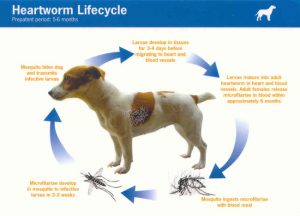
Heartworms, transmitted by mosquitoes, are long, thin worms that live in the major arteries of the heart and lungs. They can be 6-12 inches long. They breed in the heart, and their larvae circulate in the blood and can damage other organs in the body.
While many organs, such as the liver, kidneys, and heart, can all be affected by heartworms, it is mainly a disease of the lungs. Heartworms cause thickening and blockage of the arteries in the lungs. The severity of the disease depends on the pet’s immune system response and the amount of lung damage. Unfortunately, by the time most signs and symptoms are noticed, half of the lungs are involved. That is why early detection and prevention are so important . Heartworms, transmitted by mosquitoes, are long, thin worms that live in the major arteries of the heart and lungs. They can be 6-12 inches long. They breed in the heart, and their larvae circulate in the blood and can cause damage to other organs in the body.
According to the American Heartworm Society, the prevalence of heartworm disease in Minnesota is 6-25 positive heartworm cases per clinic each year. There are a coupleof thousand clinics in Minnesota, which could amount to as many as fifty thousand cases per year.
If your dog does get heartworms, they are treated with a drug called adulticide. This medication is injected into the muscle through a series of treatments by your veterinarian. While this can be done as an outpatient procedure, hospitalization is usually recommended. The medication kills adult heartworms. During the one- to two-month recovery period, exercise should be limited to leash walks because there is a risk of partial or complete blockage of blood flow to the lungs by dead worms. It is also important, after treatment, to prevent reinfection by putting your dog on a monthly heartworm preventative.
Early detection of heartworm is vital. During your dog’s annual exam, we draw blood to test for heartworm. The heartworm test that we perform also tests for Lyme disease, anaplasmosis, and erlichia. The latter three being tick borne diseases. It is important to test your dog for heartworm before starting or continuing the monthly preventative. You may be asking yourself, “If my dog has been on heartworm medication all year, why should he be tested?” The answer is, because medication is not 100%. If you are faithful about giving your dog her heartworm medication on the same day each month, that is great! However, let’s say you give her the medication, she goes outside, eats something she shouldn’t, and then vomits. She is now, unbeknownst to you, unprotected for 30 days, which is long enough for her to become infected. If your dog is infected with heartworms and starts a heartworm preventative without being tested, this could cause a rapid die-off of the immature heartworms called microfilaria. This could trigger a shock-type reaction in your pet. Even if this doesn’t happen, preventative does not kill the adult heartworms, giving the infection the opportunity to worsen.
The best thing that you can do for your puppy is to start her on a heartworm preventative as early as 6 weeks of age. Heartworm is not passed from mother to pup, and the likelihood of a puppy being exposed before 6 weeks of age is unlikely. However, we do recommend that your puppy have his first heartworm test done between 7 and 9 months old. The heartworm preventative is a monthly chewable “treat” that your puppy will look forward to receiving. What we recommend is Iverhart Max. The benefit of this preventative is twofold. First, it helps prevent heartworm; second, it also helps prevent 3 of the 4 intestinal parasites we mentioned: roundworm, hookworm, and tapeworm.
Along with a monthly heartworm preventative, we also recommend a monthly topical flea and tick preventative. Flea and tick season is from the last frost to the first frost. So in Minnesota, that means May-September. Fleas are an intermediate host for tapeworms. This means that if your dog has fleas and ingests them, he can get a tapeworm. Ticks can transmit 3 types of diseases to your dog, and they can also latch onto humans and cause disease in humans. The Lyme vaccine prevents the tick from transmitting the disease, but it does not kill the tick or prevent the tick from catching a ride in your dog’s fur and into your home. K9 advantix® repels and kills ticks for up to 4 weeks. It also kills fleas on dogs within 12 hours and prevents infestations for a month. It repels and kills fleas before they lay eggs.




